What do Atheists have to say about circumcision?
Ayaan Hirsi Ali
"The foreskin is cut off the penis. That's a form of mutilation. You should leave the child as he is, as he comes out of the womb. He's finished, he's complete. You shouldn't take things off, especially when there's no medical reason. I think male circumcision is worse than an incision of a girl. With boys, a lot of skin is removed. The consequences can be worse for boys than for girls." -In an interview
George Carlin
"I also survived circumcision, a barbaric practice designed to remind you as early as possible that your genitals are not your own." -In his memoir: Last Words
Richard Dawkins
"Creator of the Universe went to great trouble to create the foreskin. Then insisted that you cut it off. Makes sense." - Via Twitter
"If circumcision has any justification AT ALL, it should be medical only. Parents' religion is the worst of all reasons –– pure child abuse." - Via Twitter
Christopher Hitchens
"Handed a small baby for the first time, is it your first reaction to think, beautiful, almost perfect, now please hand me the sharp stone for its genitalia." -In His Book
"I can't find the compulsory mutilation of the genitals of children a subject for humor... It's designed to repress sexual pleasure... The full excision, not just the snip but the full mandatory covenant is fantastically painful, leads to trauma, leads to the dulling of the sexual relationship. And can be, in itself life-threatening at that moment. We have records, I can show them to you, of hundreds and hundreds and hundreds in the United States of boy babies who died or had life-threatening infections as a result of this disgusting practice." -Debating Rabbi Harold Kushner
Penn Jillette
"The vast majority of the world knows there’s no reason to circumcise. Someone should tell the doctors." -Penn & Teller: Circumcision is Bullsh*t
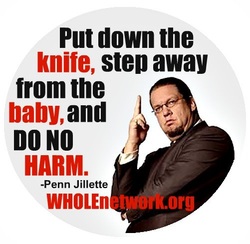
"Shouldn't our son have the choice whether he wants to wear a condom or cut off part of his dick? Put down the knife. Step away from the baby." -We're Still Right About Circumcision
Joe Rogan
"People mutilate their kid's dicks because of visuals. That's what circumcision is about. Look, I'm circumcised, I didn't ask to be. I'm sure a lot of you are circumcised. I'm sure a lot of you circumcised your kids. When you really stop and think about it, it's kinda fuckin' crazy... I would never circumcise my kid." -Live at the Tabernacle
"I think it's stupid. If I had a boy I wouldn't circumcise him... I got robbed. I got robbed. Sliced. I think it's a fuckin' gross tradition man... I just think it's a weird fuckin' tradition that we need to end. People get like, really bad infections. It's not completely innocuous- kids have lost their penises because of circumcision... It's a dick it's not a Jack-O-Lantern alright? You don't have to chop parts off of it to make it look better." -Joe Rogan Experience
Howard Stern
"I am circumcised, and I tell you something, I despise it. I despise it. I despise it... I am completely pissed off that I'm circumcised." - On his radio show
This compilation of quotes was assembled in preparation of our trip to the American Atheists Convention April 17-20 in Salt Lake City, Utah. We are currently raising funds to make our presence at this convention possible. If you appreciate the work that we do, please show your support by making a tax-deductable donation today.
Ayaan Hirsi Ali
"The foreskin is cut off the penis. That's a form of mutilation. You should leave the child as he is, as he comes out of the womb. He's finished, he's complete. You shouldn't take things off, especially when there's no medical reason. I think male circumcision is worse than an incision of a girl. With boys, a lot of skin is removed. The consequences can be worse for boys than for girls." -In an interview
George Carlin
"I also survived circumcision, a barbaric practice designed to remind you as early as possible that your genitals are not your own." -In his memoir: Last Words
Richard Dawkins
"Creator of the Universe went to great trouble to create the foreskin. Then insisted that you cut it off. Makes sense." - Via Twitter
"If circumcision has any justification AT ALL, it should be medical only. Parents' religion is the worst of all reasons –– pure child abuse." - Via Twitter
Christopher Hitchens
"Handed a small baby for the first time, is it your first reaction to think, beautiful, almost perfect, now please hand me the sharp stone for its genitalia." -In His Book
"I can't find the compulsory mutilation of the genitals of children a subject for humor... It's designed to repress sexual pleasure... The full excision, not just the snip but the full mandatory covenant is fantastically painful, leads to trauma, leads to the dulling of the sexual relationship. And can be, in itself life-threatening at that moment. We have records, I can show them to you, of hundreds and hundreds and hundreds in the United States of boy babies who died or had life-threatening infections as a result of this disgusting practice." -Debating Rabbi Harold Kushner
Penn Jillette
"The vast majority of the world knows there’s no reason to circumcise. Someone should tell the doctors." -Penn & Teller: Circumcision is Bullsh*t
"Shouldn't our son have the choice whether he wants to wear a condom or cut off part of his dick? Put down the knife. Step away from the baby." -We're Still Right About Circumcision
Joe Rogan
"People mutilate their kid's dicks because of visuals. That's what circumcision is about. Look, I'm circumcised, I didn't ask to be. I'm sure a lot of you are circumcised. I'm sure a lot of you circumcised your kids. When you really stop and think about it, it's kinda fuckin' crazy... I would never circumcise my kid." -Live at the Tabernacle
"I think it's stupid. If I had a boy I wouldn't circumcise him... I got robbed. I got robbed. Sliced. I think it's a fuckin' gross tradition man... I just think it's a weird fuckin' tradition that we need to end. People get like, really bad infections. It's not completely innocuous- kids have lost their penises because of circumcision... It's a dick it's not a Jack-O-Lantern alright? You don't have to chop parts off of it to make it look better." -Joe Rogan Experience
Howard Stern
"I am circumcised, and I tell you something, I despise it. I despise it. I despise it... I am completely pissed off that I'm circumcised." - On his radio show
This compilation of quotes was assembled in preparation of our trip to the American Atheists Convention April 17-20 in Salt Lake City, Utah. We are currently raising funds to make our presence at this convention possible. If you appreciate the work that we do, please show your support by making a tax-deductable donation today.



 RSS Feed